Tuesday, September 10, 2019

The Memorials of 9/11 - A Personal Journey


It is 18 years ago that the eyes of the world woke up to the news that the word "terrorism" had taken on a whole new meaning. The hijacking of four airliners by 19 terrorists and then using them to deliberately crash them into buildings was something that both shocked and horrified every person who had even an ounce of compassion. The two famous "twin towers" of the World Trade Center in New York City fell in clouds of dust within two hours, an entire side of the Pentagon collapsed in a heap and a fourth plane was taken over by it's passengers and crashed into a field in Pennsylvania before it had chance to conduct it's deadly mission - a sacrifice that immortalised the heroic players in that fight back.

11th September 2001 was without doubt a day that shocked the world and like everybody else it started off like any other day for me, sat out at sea on a ship in the middle of the Mediterranean enjoying the sun and looking forward to getting in to Turkey in two days time. That afternoon, after we had finished work, one of the lads came into the mess deck and announced that terrorists had flown planes into the twin towers and that the Pentagon had also been hit. This was surely too far fetched?

I raced up to the radio room and walked up to the man dealing with the messages. "How's it going?" I said casually. "Haven't you heard?" came his reply. It was then I knew that this was no joke as he turned the signal around for me to read. With the internet not at it's greatest ability we managed to upload the BBC News front page and as the first image popped up on the screen of the side of the tower erupting in a fireball, we all just looked shocked. All kinds of questions ran through our heads. Who would do something like this? How many people have been killed? What are going to be the repercussions?

As we pulled into Turkey two days later (with the newspapers here being a day late from the UK) I managed to see the first reports and there the news remained for months, it was all what came to be known as 9/11 and what turned into a war in Afghanistan lasting over a decade.

So as the dust settled and the years went by, I have decided to share with you all the numerous memorials that I have visited around the world that have commemorated the attacks and remembered the victims.

So I will start with New York itself. In August 2017 there was an opportunity to join my in-laws with their American road trips and with a stop over in the Big Apple I wanted to see for myself where these terrible events took place.

The first thing you see is the incredible structure that is the World Trade Center today, built right next to where the twin towers once stood as a show of defiance to any terrorist - we will not be beaten! Rising 1776 ft tall, the elevator ride alone takes your breath away with an animation of how the city was built from mere vegetation to the megalopolis that you see today. A counter with the years tick by in the top corner as you watch buildings rise from all corners, for a brief few seconds the two towers appear then disappear next to you before the doors open. The scene from up there is nothing short of breathtaking, the city spread out like a model village below.
Leaving the WTC you are immediately drawn to the two massive waterfall pools, the original footprints of the towers. Around each of these adorn the names of all those who died in the attacks that day, a rose being inserted into the name of those whose birthday it is today.

The museum in the underground section is both sombre and fascinating. The stories told in here speak volumes about the buildings, the attacks, the people and the lives lived within these buildings in the two decades that they were standing tall. Items on display range from gift shop souvenirs to pieces of the airliners that were used as missiles by the terrorists. A huge piece of the tower which served as a kind of centrepiece for the photographers during the clearup operations is adorned with the graffiti of numbers - the numbers of firefighters lost, police officers from different departments and civilians dead. The remains of a fire truck and the antenna at the top of the North Tower leaves you under no doubt that this huge event that shook the world happened not in some faraway country, but right here at this very spot.

New York has various other memorials to the attacks. At the USS Intrepid, a Vietnam-era aircraft carrier moored at pier 86 down the Hudson River a piece of WTC steed is shaped into a memorial. A plaque at Liberty Island under the famous statue has a Memorial Grove of trees, Battery Park held the famous sphere that once stood between the two buildings and a huge firefighters mural stretches down Greenwich Street and leads the way to more museums dedicated to the event.

The 9/11 Tribute Museum was one that I visited which was just as fascinating as the others. Despite the event being the same, it's amazing just how different they can be. How many more different versions of events could be found? How many exhibits could you possibly get? Who knows. But each one is worth a visit in itself and for somebody who wants to know as much as possible about the events of that day then there is never a shortage of places to go for information. I didn't get chance to see loads more including an exhibition of photographs and various other plaques. The city is simply just too big to discover everything in such a short space of time.

St Pauls Church had a lucky escape when the towers fell, the plaque there today telling the visitor that on the first anniversary a bell was placed in the churchyard to be rung out every anniversary, a symbol of both remembrance and a lucky escape for the historic church. A small Greek Orthodox church closer to the towers was not so lucky and remains one of the smaller less known stories of the fall of the towers.

So we move away from New York and head over the water to New Jersey. Another monument originally to the Polish dead of Katyn Wood during the Second World War now has an image of an angel weeping at the burning towers. Both powerful and upsetting.

Up the road is the memorial known as the Empty Sky. You will find that in Liberty State Park, normally a place where you head off to get the ferry over to Liberty and Ellis Islands, but not far from the terminals is two walls, set apart by just a few feet and pointing directly to the site of where the towers once were. When we arrived there the sun was shining at the perfect angle and created what can only be described as a diamond ring illusion, with the silence of the park and the image before you, it is difficult to to feel emotional at this. Steel from the towers stands at the entrance with inscriptions of those who died running up the sides of the walls.

Also in New Jersey after a short drive away is what can only be described as one of the most beautiful monuments I have ever seen. The Teardrop, donated by Russia, stands 100ft tall overlooking the water towards the site of the towers with a 40ft teardrop hanging through the middle like an oddly shaped needle. The names of the dead run in a circle around the bottom of the monument. What impressed me is that they have included the six who died in the 1993 attack, when a truck bomb detonated in the car park in the first attempt to bring down the towers. 1000 people were also injured that day but the towers stood tall.

So the road trip continued over to Baltimore where a very unique memorial stood outside their city World Trade Center. As I was looking at the twisted steel that made up the monument a segway tour stopped where I overheard the guide tell the people that the memorial was inscribed with lines giving the dates and times of events. Apparently on 11th September the shadow of the building hits those lines at the exact times as the day goes on. If this is true then this is a remarkable feat of planning and engineering. Other stones close by simply say "Pentagon" and "Fight 93, Shanksville, PA."

One thing I did notice is that the 9/11 attacks are not just monuments outside in the street, the stories in museums show their own artefacts, stories and personal effects. The Smithsonian museum and the Ronald Reagan Trade Centre in Washington DC both have steel from t
he towers, the trip taking us over to the small town of Gettysburg where you can still see how they remember the day, despite their own history as being the bloodiest battle of US soil during the Civil War.

My final visit in the States took me to the Pentagon, the site of the crash of flight 77 which cost the lives of 184 more lives. The area where the building collapsed is now repaired and you would never guess that anything untoward had ever happened here. A memorial garden of trees with pools adorned with the names of those who died is set in a background of high security reminding you that the Pentagon is still a US Government building under top surveillance, so much so that you are told not to photograph the building if you are visiting this memorial garden. 


But it is not just the USA where you will find memorials to these attacks. 67 Britons died that day and so a memorial to them was built in Grosvenor Square in London. What looks like a temple complete with columns in a Greek style like a mini acropolis, the names of those lost from the UK in three bronze plaques (below right).

Gdynia in Poland has a small solidarity plaque near the seafront, today a demolition crew is tearing down an old leisure centre but thankfully the memorial is not being disturbed. This is one of those smaller plaques that you would literally miss it if you blinked. For this one you head towards the historic warship Blyzkawica straight ahead, this is on the left hand side as you walk towards it (below).


So these are the monuments I have visited myself which commemorate the September 11th attacks. I have no doubt that there will be many more over the coming years that I will manage to make that journey to and gaze upon the memorials to the citizens of other countries. There have been hundreds of terrorist attacks in just the last 20 years, the cities of London, Paris, Brussels and Berlin have joined the names that were splashed on the front pages. Memorials will continue to be erected to the dead in such shocking events and it is up to us as the good citizens of this world the help keep the memories of these people alive so they continue to be a part of our history. But most of all we remember the heroes of all four flights, the fire crews, the police, the unsung rescuers, the office workers and the people left behind to deal with the pain.


It is too big of an event to ever forget, but we will be assured that the names of the lives lost on that dreadful day 18 years ago will forever be remembered.


Sunday, September 8, 2019

Sinking of the Munchen

The cargo carrier Munchen was launched in 1972 and was 857ft long which made her one of the biggest cargo ships in the world, plying her trade between Europe and America.

It was on one of these journeys in December 1978 that Munchen found herself in trouble. In the early hours of 12th December a distress call was heard from her which alerted a French radio station that she was in peril somewhere mid-Atlantic. Other ships picked up broken messages which may have come from her, but a rescue operation was immediately launch. It would be all in vain.

That was the last anybody ever heard of her. Her 28 crew and full load of cargo were lost at sea without a trace.
It was known that the ship was sailing into a storm but this wasn't abnormal especially for a ship the size of Munchen. Over the next ten days a huge search was underway which located her EPIRB (emergency beacon), several lifeboats, rafts and various other lifesaving equipment.

Investigations were carried out which led to the conclusion that she had been struck by rogue waves which knocked out her radio equipment and sank her slowly, but there was nothing ever conclusively given as the cause, it was all just theory and speculation.

Her wreck has never been found.

A large model of the Munchen today sits in the Laboe naval memorial in Kiel, Germany. The sinking has featured in several documentaries also suggesting it was a rogue wave. Until the remains are found we will never know for sure.

Thursday, September 5, 2019

Battle of Narvik 1940

The small town of Narvik in Northern Norway is the centre point of the iron ore trade which branches out in all directions from the Arctic Circle down to Oslo and beyond. It was this trade that made the area a very important target for Nazi Germany and sure enough the expected invasion was soon to take place in early 1940 in order to secure this land.

The Royal Navy though was already a step ahead and a fleet of ships was already deployed to protect the area despite the growing presence of German warships in the seas around Narvik.

On 9th April 1940 the invasion took place which swiftly sent the two Norwegian warships Eidsvold and Norge to the bottom during a battle involving no fewer than ten German warships. The land was taken in no time at all and the British had to act fast in order to prevent the situation getting worse.

The following days saw ship after ship sunk in this small area of water, the fjords now littered with dozens of shipwrecks from all sides. Ironically the German warships were by now sat around stranded due to the lack of fuel, their tankers being able to get through to replenish the units.

By the end of May 1940 the land had been retaken but unfortunately it was the smallest of victories as Norway fell less than a month later and the Allies withdrew from Narvik.

Today there are remnants of the Battle of Narvik all around the town and in July 2019 I had the opportunity to see them for myself.

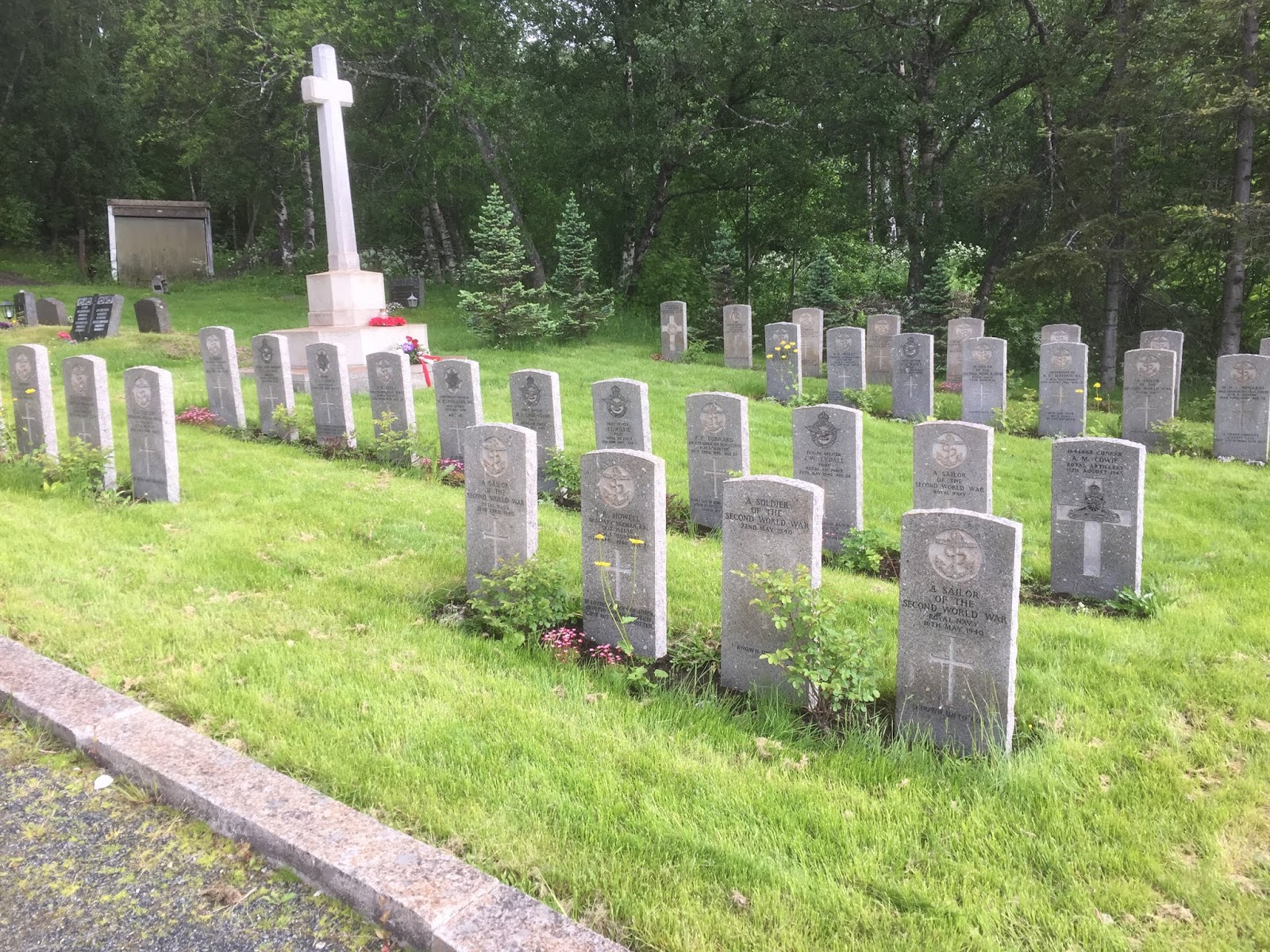
To start with I visited one of the Commonwealth War Cemeteries which had dozens of graves from the loss of the British warships Hunter, Hardy and Acasta as well as a section of German graves on the other side of the cemetery. Just this one place really brings it home to you just how many individual sailors alone were killed on these ships. Each person buried here had friends, a family, a home and a story. Some just say "A Sailor of the Second World War" and may never now be identified.

A memorial in the town centre honours those lost on the two Norwegian ships Eidsvold and Norge. These two put up an incredible fight against all odds and were the first casualties of a long battle. Today a peaceful memorial garden is dominated by a free standing stone marking the loss of these once proud ships.

Nearby to the memorial is the Narvik War Museum, a building which is packed with information and relics from 1940 telling the story in several languages and giving an easy to understand view of the events leading up to the invasion as well as displaying some incredible artefacts from some of the wrecks of those ships which over the years have been located and dived upon. A light show over a map of the fjords shows the visitor what happened day by day and gives you a better realisation of the horrors of the war and the history of this tiny town.

But the highlight of this trip was the visit to a site far away from the main town but one which was well worth doing. Taking a car across the bridge onto the main road and then back over the other side, down a country road surrounding by hills and trees and parking up where the road ends near a utilities station, we had to go the rest of the way on foot. Heading through foliage and mud, climbing over rocks and hanging onto tree branches, it was soon apparent that my shoes and jeans were suffering, not that I cared about this by now. For we had come to see the wreck of the German destroyer Georg Thiele, run aground deliberately during the campaign in order to save the crew from certain death after taking heavy damage.


The wreck today is in the exact same location but is now upside down, brown with rust and her bow up on the rocks. The 390ft long ship is now mostly underwater and is a fascinating dive site, but the foc's'le remains above water for you to see, the damage to the underside now exposed, along with the various holes which expose parts of her machinery spaces. Bollards and anchor holes remind you that this was once a fine vessel of fighting capability with a proud crew and a shining personality. Today she is a piece of history that is there for all to see for those who can be willing to make the journey. A journey that is well worth it if you love history and want to see first hand this amazing relic.


The Battle of Narvik is today remembered in the history books and has featured in only a few documentaries and it seems that it is still very much overshadowed by the bigger campaigns of the Second World War. The memories of what happened here together with the graves of all those who died during this campaign will forever lay quietly in a corner of those cemeteries or sit undisturbed underwater in the steel coffins that litter the waters of this tranquil slice of Arctic paradise.


But thanks to the residents of this town and the historians who study this battlefield, the story of what happened here almost 80 years ago will never fade away.

Tuesday, August 27, 2019

Sinking the Tirpitz

The Second World War has many memorable ships and among those which are remembered the most are the bigger ones that struck terror into the heart of their enemies. After the Bismarck was sunk in 1941 the allies turned their attention to her sister ship Tirpitz which was almost identical and just as deadly.

The chase was on to make sure this behemoth didn't have a chance to break out into the Atlantic and attack the convoys. The smaller German warships Scharnhorst, Gneisenau, Admiral Hipper, Admiral Scheer and Admiral Graf Spee had all made successful attacks on merchant ships, sinking not only thousands of tons of shipping but in some cases warships fell victim including the aircraft carrier HMS Glorious.

The Tirpitz was launched from her builders at Wilhelmshaven on 1st April 1939 and although she was immediately the target of air attacks on the harbours where she was being fitted out nothing ever struck her while this period of her initial trials was taking place.

In early 1942 she was deployed to Norwegian waters in order to give easy access to the Atlantic and Russian convoys but shortages of fuel led to a reduced ability to conduct operations and therefore led to her languishing in fjords most of the time. On 31st December 1942 she conducted the firing of her main guns on the island of Spitzbergen which was followed by her simply returning to Trondheim.

On 22nd September 1943 she came under attack from something that had never been seen before. Tiny submarines that can fit up to 5 people on board named X-craft were deployed with explosive charges attached to the side of the sub that could be released at a moments notice. Trained in absolute secrecy, the "X-men" would cut through the anti-submarine netting at Kafjord, the Tirpitz's new home for now. The mini subs would be towed across the North Sea from Scotland and up as far as they dared go on the surface before three of them would be released to carry out the attack. Two of these craft successfully planted charges, a third vanished without trace. The crew of the two craft surrendered when threatened to be sunk by the ships crew, the charges detonating under them not long after. Despite the British losses they had successfully caused enough damage to prevent the Tirpitz from sailing. (The model above is at the Royal Navy Submarine Museum in Gosport)

3rd April 1944 saw a wave of bombers attack the ship which caused damage to the superstructure and over 100 deaths. More attacks followed over the coming months that told the Germans that there was going to be no let up in the stopping of this ship. Despite the persistence of the bombers the ship was still technically operational and still posed a threat. By now the ship had been moved to Tromso where she lay at anchor once again.

This led to Lancaster bombers from No's 9 squadron and 617 "The Dambusters" squadron attacking the ship on 12th November 1944 in a mission that saw the dropping of Tall Boy bombs, explosives that caused huge craters when they missed and devastating damage when they hit on target. By now Tirpitz was no match for the explosions that reigned down that day, she was flooding within minutes and when a reconnaissance pass was conducted around an hour later she had turned upside down.

Over 900 crew died in her sinking, the wreck being sold after the war and salvaged between 1948 and 1957. The Norwegian salvor in charge became a millionaire from the scrap metal sold.

In July 2019 I visited the site where the ship met its final demise and it is hard to believe something so big would be sat there upside down for so long. A peaceful and tranquil island surrounded by wildlife and calm waters, a metal memorial constructed from the wreck's hull stands nearby, a red buoy marking where the few items still remain on the seabed. This is sometimes visited by divers and a few small items remain on the beach nearby such as the anchor chains and a mounting for a 20mm gun.


On the other side of Tromso is a Second World War bunker which is now a museum to the Tirpitz, not only telling the story of this ship and her last moments but this contains items that could not be sold for scrap but were taken home as souvenirs. These items have been tracked down over the years and displayed here for all to see - a raft, dials, gauges, a door, a clock with the eagle and swastika marking and a host of other fascinating items.


More Tirpitz items are in a separate museum near Kafjord but that was too far away to attend.

Although Bismarck always gets the books written and the documentaries telling her life, her sister ship will always have her own stories and her crew will always be remembered by the one remaining survivor and naval historians across the globe.


Friday, August 23, 2019

Titanic - The Bridlington Connections

On Monday 19th August 2019 I had the pleasure of officially introducing to the world my tenth book, this one about the most famous ship in the world and it's links to the East Yorkshire town of Bridlington.

When Titanic set sail on 10th April 1912 from Southampton there was not a person on Earth who could have predicted the implications of what was about to happen to her just four days later. Several lucky passengers departed at Cherbourg and Queenstown and that was the last time the ship was seen by anybody from the land.

History (and a host of Hollywood films)  will tell us the story of what happened the night the ship hit the iceberg and sank. It is a story that has been retold so many times you would think that there were no longer new things to talk about - but you would be wrong.

In 2014, after realising that the ships band leader Wallace Hartley had played in Bridlington in the early 1900s, I began a campaign to have a plaque installed at the Bridlington Spa which was agreed upon by East Riding of Yorkshire Council and unveiled in the summer of that year, local historian Mike Wilson taking my place due to me being away at the time.

But as the years went by it became apparent that Hartley was not the only link to the Titanic and Bridlington. A violin was located and confirmed as being the actual instrument he played as the ship was sinking - a scene immortalised forever in every book and film almost! Selling at auction for over £1 million, this really put the town on the map in Titanic circles.

However, it turned out that the senior surviving officer of the Titanic was shipwrecked in Bridlington Bay during the First World War. Charles Lightoller was no stranger to being shipwrecked. After being  stranded for 8 days following the loss of the barque Holt Hill in 1889 he went on to become Second officer of Titanic and then First Officer of the Oceanic which sank in 1914.

In March 1918, as captain of the destroyer HMS Falcon, he was zig-zagging his ship during convoy escort duty off the Yorkshire coast when the armed trawler John Fitzgerald collided with his ship and split the vessel in two.

The bow section sank immediately but after several hours of attempting to save the stern, Lightoller and his two remaining crew abandoned ship. One person died of his injuries later.

The wreck of the Falcon was located in 1996 by Bill Woolford in Bridlington Bay and since then he has recovered several items which he has lovingly restored.

With two other chapters dedicated to the local newspaper reports on the sinking of Titanic and the local people who have the Titanic in their life in one way or another, the books is packed with information that both locals and Titanic experts will find interesting and informative.

I would like to thank Bridlington Central Library, particularly Sarah Hutchinson, who made the talk possible and gave me the opportunity to share my knowledge of this amazing subject.

For me it all began in 1991 when I first watched the film Raise the Titanic. Despite the fact it was completely fictional it sparked an interest that continues to this day and has led to visiting places around the world that I would have never dreamed of seeing as well as a passion that has so far lasted 28 years....and counting.

Giving talks and distributing my information to those interested is my passion and one that I will continue to do for many years to come. I have many other projects being worked on and have already been booked for further lectures which I do in my spare time while holding down a full time job!

But for me it would always start with a small boy watching his first Titanic film all those years ago.

For those interested in purchasing a copy of the book then please email shipwreckdata@yahoo.co.uk for details or follow me on Facebook - Richard M. Jones


Tuesday, August 13, 2019

The Legend That is Bismarck

You might not think that Teenage Mutant Ninja Turtles would spark a fascination with a sunken German battleship, but as an 11 year old boy holding one of these kids novels back in 1992 that is exactly what happened. This pack of children's books given to me at Christmas was something of a turning point in my life and it certainly wasn't to do with the Turtles! In one of these books the heroes find themselves in a situation where relics from the seabed are being salvaged and right at the very end (spoiler alert!) the nameplate of the Bismarck drops on the deck and the mystery is solved. This is the point where I found that this was a real ship and I was desperate to find out more.

Within weeks I had found the book Exploring the Bismarck in the local bookshop and to my astonishment the author was Robert D Ballard......with the words underneath "Discoverer of the Titanic" which was already becoming an obsession of mine.

So the years went by and Bismarck still fascinates me today just as much as it did when I was a young lad.

The story of the Bismarck begins just before the start of the Second World War when what became the worlds largest warship was constructed at the Blohm and Voss shipyard in Hamburg, Germany, with a launch on 14th February 1939 by Hitler himself. This overtook the current record of
largest warship which at the time was the British battlecruiser HMS Hood.

For the next two years the Bismarck was fitted out with her machinery, equipment, stores and most of all her crew. Over 2000 sailors manned their stations and with the war now in full swing it was time to see the ship flex her muscles.

Code named Exercise Rhine, she slipped out of German waters and headed north past Norway in company with her escort ship, the cruiser Prinz Eugen. But this was a badly kept secret when both a Swedish cruiser and a British Spitfire spotted her. Not only that several ships of the Royal Navy not only saw her but began tracking her where they suspected she would break out into the Atlantic using one of several passages. Ships moved into position in anticipation of a forthcoming battle.

The route Bismarck chose was the passage between Iceland and Greenland, known as the Denmark Strait. On 24th May 1941 the two ships met their nemesis for the first time - HMS Hood (left) along with the brand new battleship Prince of Wales. What happened next shocked the world - Just a short, sharp battle saw the Hood explode and sink with only three survivors. Prince of Wales was too damaged to continue and retreated. The two German ships carried on their mission in triumph but not without finding out that Bismarck had taken a small amount of damage - a hole causing an oil leak. Nothing too bad but one that would provide their enemies with a location beacon.

Following the loss of Hood, Bismarck and Prinz Eugen went their separate ways and the battleship made the decision to head to France for repairs. Using a high seas manoeuvre that confused the Royal Navy for a short period of time, Bismarck did a double back on herself and disappeared.

A period of 24 hours went by where ships and aircraft frantically searched for this terror of the seas, it was on 26th May that a Catalina flying boat located her and radioed her position upon sighting. By now she was too far away for the capital ships to catch up, but not for the Swordfish biplanes from two of the pursuing aircraft carriers HMS Victorious and HMS Ark Royal.

Several attacks by these tiny aircraft, which carried just one torpedo each, left the Bismarck crippled by one particular lucky shot. A torpedo almost missed the Bismarck and instead detonated at her stern, jamming her rudder during a turn and causing the mighty battleship to start sailing in huge circles - a situation that meant the huge fleet of pursuing warships could now catch up to her.


On the morning of 27th May 1941 the fleet attacked and in around two hours of heavy fighting the Bismarck was doomed. Salvos from HMS Rodney and HMS King George V as well as torpedoes from HMS Dorsetshire meant that there was no going back and fires broke out all around the vessel. The order was given to scuttle the ship but the damage caused would have caused her to sink either way. At 1039 that morning the ship raised her bow into the air and rolled over, hundreds of German sailors were now struggling for survival in the Atlantic.

Although the British tried to rescue as many survivors as possible, word came through of a U-boat sighting and they were forced to retreat. Out of a crew of 2200, only 114 survived.

The survivors were taken to prisoner of war camps in Canada before being released after the war, each one holding their own memories of a ship that lived on her first mission for less than two weeks.

Bismarck once again made headlines when Robert Ballard led an expedition to search for the wreck. In 1988 he discovered wreckage but this turned out to be the remains of an old sailing vessel. He returned the following year and on 8th June 1989 the first images of the Bismarck wreck were seen for the first time on board his research vessel Star Hercules.

Ballard conducted the first survey of the wreck and found that all four of her main guns were gone (held in by their own weight they fell out when the ship capsized), her stern had broken away near the point of where the torpedo had struck and a lot of the superstructure had been swept away. The most haunting image was the huge swastikas on both the foc's'le and stern which had been painted over in 1941 to prevent enemy identification. This plus the vast amount of sailors boots that lay on the seabed.....some of them in pairs where the owners had landed nearly five decades before.

Since the first expeditions there have been other visits to the wreck which have shown the world the Bismarck from some incredible angles. In 2001 shipwreck hunter David Mearns discovered the wreck of the Hood and paid a visit to the Bismarck on the same expedition, showing both warships in a fascinating series of documentaries like never seen before. Oscar winning movie director James Cameron of Titanic fame also filmed the wreck using the latest technology to see the wreck in even greater detail.

Today the Bismarck has memorials to her dead as does the Hood. Commemorations of both ships take place side by side, although today there are no survivors left from either ship, the last Bismarck survivor passing away in 2018.

The ships are not only remembered but celebrated for the marvels of technology that they were. The battles are pored over by historians and authors, museums allow visitors to marvel at their displays and books telling the story of these incredible war machines will forever keep the memory of the Bismarck and all her sailors alive.


Memorial at the Laboe naval memorial, Kiel, Germany (June 2019)


Sunday, August 11, 2019

The U-boat wrecks of Yorkshire

Many years ago a friend showed me a book called Shipwrecks of the Yorkshire Coast which detailed hundreds of vessels that had come to grief in the area between the River Tees and the River Humber. From sailing vessels of centuries ago to the modern day fishing vessels that still plough these waters, the Yorkshire coast is littered with relics and treasures from years gone by. One estimate puts the number of wrecks in the area as high as 50,000!

Among the vessels that have gone down off this area are the German submarines, better known as U-boats, that sent millions of tons of allied cargo to a watery grave by attacking their merchant ships using their torpedoes and deck guns. The First World War introduced this menace of the sea to a horrified world with the sinking of the luxury liner Lusitania bringing home just how dangerous one of these U-boat attacks could be. But it wasnt just the merchant ships that were lost at sea, the submarines themselves became victim of counter-attacks and mines. The amount of people who died on these steel coffins is staggering.

I had the opportunity to visit Kiel in June 2019 and was able to see both the Laboe naval memorial and the U-boat memorial, two magnificent monuments dedicated to not only their country's lost sailors but the sailors of every nation in both peacetime and war. With the names of every U-boat sunk in numerical order it made shocking reading of just how many people were lost in this one aspect.

The North Sea was no exception to the horrors of war and despite the attempts at disguising the merchant ships and concealing defensive weapons they still fell victim to the U-boats.

But the battle was not one-sided..... over those four years 1914-1918 the German navy would lose almost 200 submarines and today a lot of these wrecks have been found and visited by divers. Here are the ones that were lost off the Yorkshire coast. 

UC-39


UC-39 was spotted off Flamborough Head by the destroyer HMS Thrasher which forced her to the surface using depth charges before finishing her off with gunfire on 8th February 1917 killing 7 of her crew. The wreck was discovered and visited by divers who removed her propeller and various fittings. 

One of her propellers is today on display at the Bridlington Harbour Heritage Museum and the steering mechanism is on display in a local village pub called the Ship Inn which sits on the cliff tops at nearby Sewerby


The image above left shows the names of those lost on the submarine at the Kiel U-boat memorial, Germany.

UB-107

This submarine has become somewhat one of the more mysteries sinkings of the war. Sunk on 27th July 1918 in the North Sea after apparently being depth charged by HM Yacht Vanessa and HMT Calvia, when the wreck was found off Flamborough Head in 1985 it was actually located miles from where she was reported being sunk and investigation concluded she was actually sunk by either a mine or by accident and not by depth charges as first reported. What is even more incredible is that the wreck is tangled up with that of another vessel, the cargo ship Malvina which was sunk a week AFTER the supposed loss of UB-107. The mystery of this submarine has never been solved but one thing is for sure.....none of her 38 crew survived. Their names are on the Kiel U-boat memorial (below).


UC-75

The UC-75 had an incredible career in her few years with a total of 56 merchant ships and one warship sunk as well as 8 other merchantmen damaged.

The toll of ships sunk would go up by one in her last mission - but not as she would expect it. The loss of this U-boat actually cost the Royal Navy dearly when on 31 May 1915 she was sighted by a convoy and rammed off Flamborough Head by the destroyer HMS Fairy which became so badly damaged that she started taking on water and vert soon joined the UC-75 on the seabed. 17 crew of the submarine died but 14 others survived including two who managed to leap onto the Fairy during the collision.

The wreck of both UC-75 and HMS Fairy have been located, the propeller of the submarine having a journey of its own when it was salvaged illegally and her propellers kept in storage for many years in secret before they were eventually found and seized in 2017, just in time to save them from being sold for scrap. One was handed over to the National Museum of the Royal Navy and the second was given back to the German navy where it is now on display at the Laboe naval memorial near Kiel.

As for the Fairy, her gun was salvaged and for many years stood proud on the south side of Bridlington Harbour before it was removed in the early 2000s and placed in storage. It would be nice to see this back on display sometime soon.


(Right) shows the list of her lost crew at the Kiel U-boat memorial.


There are so many others that litter the seabed, each one having its own story and its own crews lives to explore. Most have been found and photographed by divers, some have had parts taken from them.

UB-75 (not to be confused with UC-75) sank on 10th December 1917 off Scarborough after hitting a mine. All 34 hands lost.

UB-41 was also sunk off Scarborough, on 5th October 1917 with all 24 hands after striking a mine.

UC-70 lost off Whitby lost on 28 August 1918 after being depth charged by HMS Ouse. All 31 crew lost.

UB-30 sunk off Whitby 13 August 1918 by armed trawlers dropping depth charges. All 26 crew lost, the wreck was dived on just days later and identified.

UC-47 sunk off Flamborough Head on 18 November 1917 after being rammed and depth charged by patrol vessel P-57 and sank with all 28 hands


While former enemies are now firm friends, it is easy to forget sometimes that the people lost in these vessels were ordinary people who had either joined the navy or had been conscripted just like those in Britain had. No matter what their political views it should remain at the forefront of everybody's mind that these men had families, loved ones and lives of their own and although the war has been over for 74 years we remember all the victims no matter which side they were fighting for. With the former U-boat U-995 on display and the silence of the memorial wreath laying area underground, this is what makes the memorials at Kiel such a significant place and one that everybody should pay a visit to.